A source of funds certificate for crypto is a document that shows three things: where specific coins came from, what path they took on-chain, and that the wallet holding them is genuinely under your control. It combines transaction records, AML risk screening, and ownership proof in one place. A tax report covers only the first part — which is why exchanges and banks keep asking for more.
The question usually comes up at a bad moment: an exchange holds a withdrawal, a bank queries an incoming transfer, and the support ticket asks for “proof of source of funds.” Many holders respond with a tax report and are surprised when the case stays open. This guide explains what reviewers actually check, and what a complete answer looks like.
Source of Funds vs Source of Wealth
The two terms are often used interchangeably. In a compliance review they are separate questions, and mixing them up means sending the wrong documents.
Source of Funds (SoF). Source of Funds is the direct origin of the money or crypto used in a specific transaction: the salary that funded a purchase, the exchange where coins were bought, the wallet that sent them. A reviewer wants to trace these particular assets back to a legitimate, documentable starting point.
Source of Wealth (SoW). Source of Wealth is the bigger picture: how you accumulated your overall net worth over time — employment, a business sale, investments, an inheritance. It explains why you plausibly own this much in the first place. Reviewers ask for it in higher-risk cases, for larger amounts, or in long-term relationships.
Both are standard requirements, not an exchange being difficult. The FATF Recommendations require institutions to establish source of wealth and source of funds in higher-risk situations, and the EU’s new Anti-Money Laundering Regulation (Regulation (EU) 2024/1624), which applies from 10 July 2027, makes SoF and SoW enquiries an explicit part of enhanced due diligence across all member states.
Crypto adds one layer the classic definitions never had to deal with: the assets live in wallets, and a wallet address is not a name. Before a reviewer cares where your funds came from, they need to know whose wallet they are looking at.
What a Compliance Reviewer Actually Checks
When a compliance team reviews a crypto SoF case, they are working through three questions:
- Origin of the assets. How were the coins acquired — purchased with declared income, earned as payment, mined, received as a gift? Each origin needs a record behind it.
- The on-chain path. What did the coins touch between origin and today? Public blockchains are transparent, and analytics tools flag exposure to sanctioned addresses, mixers, hacked funds, and high-risk services. A clean purchase four years ago does not help if the coins later passed through a flagged counterparty.
- Control of the wallet. Is the address actually yours? Under the EU’s crypto transfer rules, exchanges must verify whether a self-hosted wallet is owned or controlled by their customer for transfers above EUR 1,000, and EBA guidance lists the acceptable methods — including a signed message and a micro-transfer test. Our FATF Travel Rule guide covers how these transfer rules work in practice.
Exchange help pages confirm the same pattern. Kraken and Coinbase both describe requesting documents that show how funds were earned and how they reached you — not just what you reported to the tax office.
Why a Tax Report Is Not Enough
A crypto tax report answers one question well: did you declare your gains. That matters, and it belongs in your file. But it leaves the other two questions open.
- It does not prove the wallet is yours. Tax software lists whatever addresses you paste into it. Anyone can add any public address to a portfolio tracker — the report contains no cryptographic link between you and the wallet.
- It does not screen counterparties. A tax report aggregates transactions to compute gains and losses. It does not check whether an incoming transfer originated from a sanctioned entity, a hack, or a mixer, because that is not what tax software is for.
- It is self-declared. The reviewer sees data you compiled yourself, with no independent verification of completeness or integrity.
So a reviewer holding only your tax report still cannot close the file. They know what you declared. They do not know that the wallet is yours, and they do not know whether the funds touched illicit counterparties. Those are exactly the gaps that keep withdrawal holds in place.
The Components of a Strong SoF Package
A package that helps a reviewer close the case quickly typically contains five things:
- Purchase records. Bank statements showing fiat transfers to an exchange, invoices, or payslips if the crypto was bought from income.
- Exchange statements. Trade history and deposit and withdrawal confirmations, exported from each platform you used.
- On-chain history. The relevant transaction IDs and addresses, with a short explanation of major inflows.
- Ownership proof. Cryptographic evidence that you control the wallet — a signed message or a verified micro-transfer, not a screenshot.
- A screening result. An independent AML risk check of the wallet covering sanctions, mixer, and illicit-flow exposure.
One quiet rule ties it together: the documents must tell the same story. Dates, amounts, and addresses should match across the bank statement, the exchange export, and the chain. Preparing this before anyone asks is far easier than reconstructing it during a hold — the self-hosted wallet risks guide walks through that preventive workflow.
Where a KYW Certificate Fits
Of the five components, the last three — on-chain history, ownership proof, and screening — are the hardest to produce by hand. That is the part a Know Your Wallet (KYW) certificate covers.
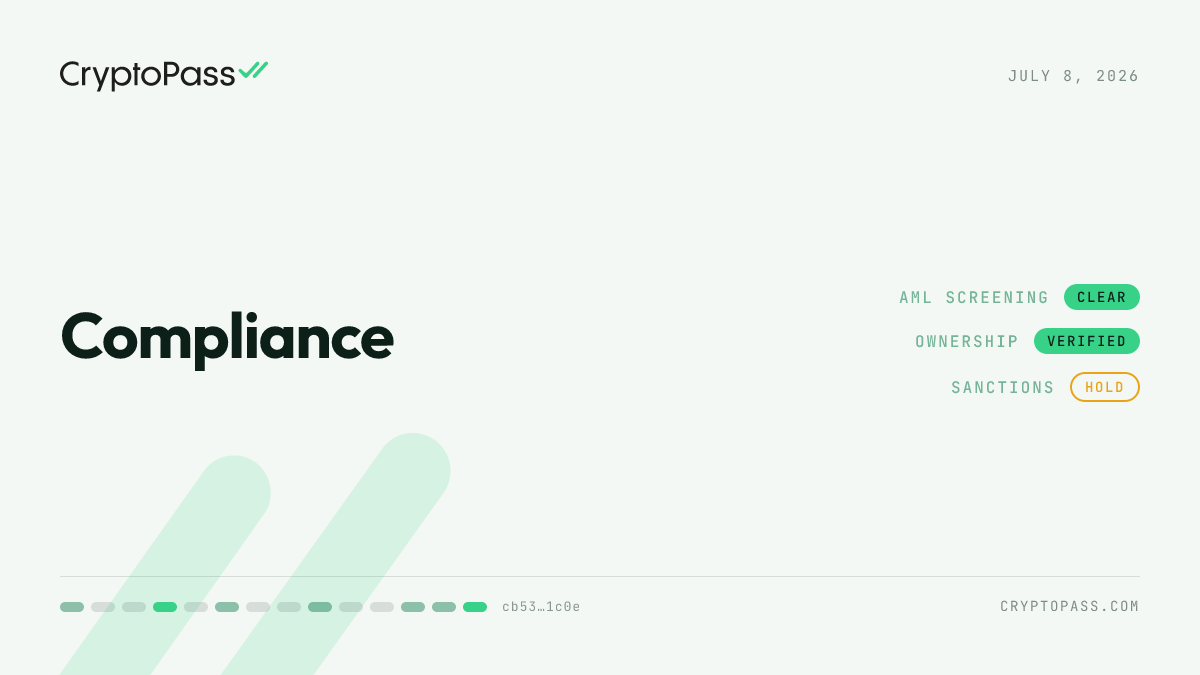
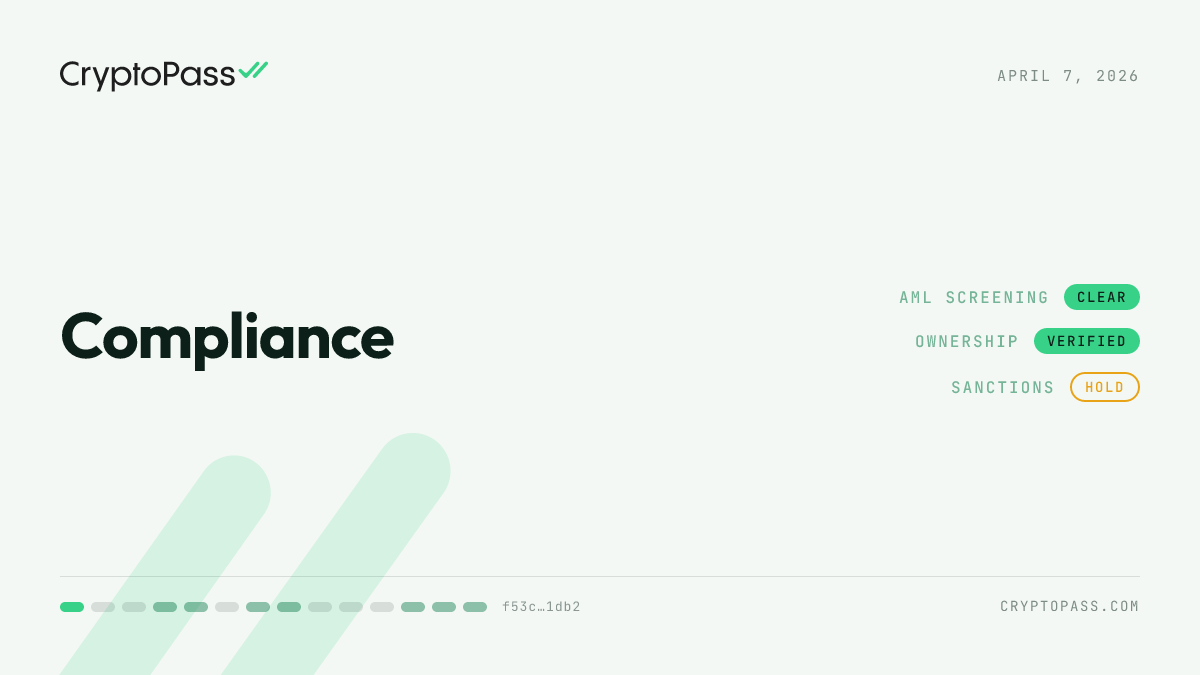
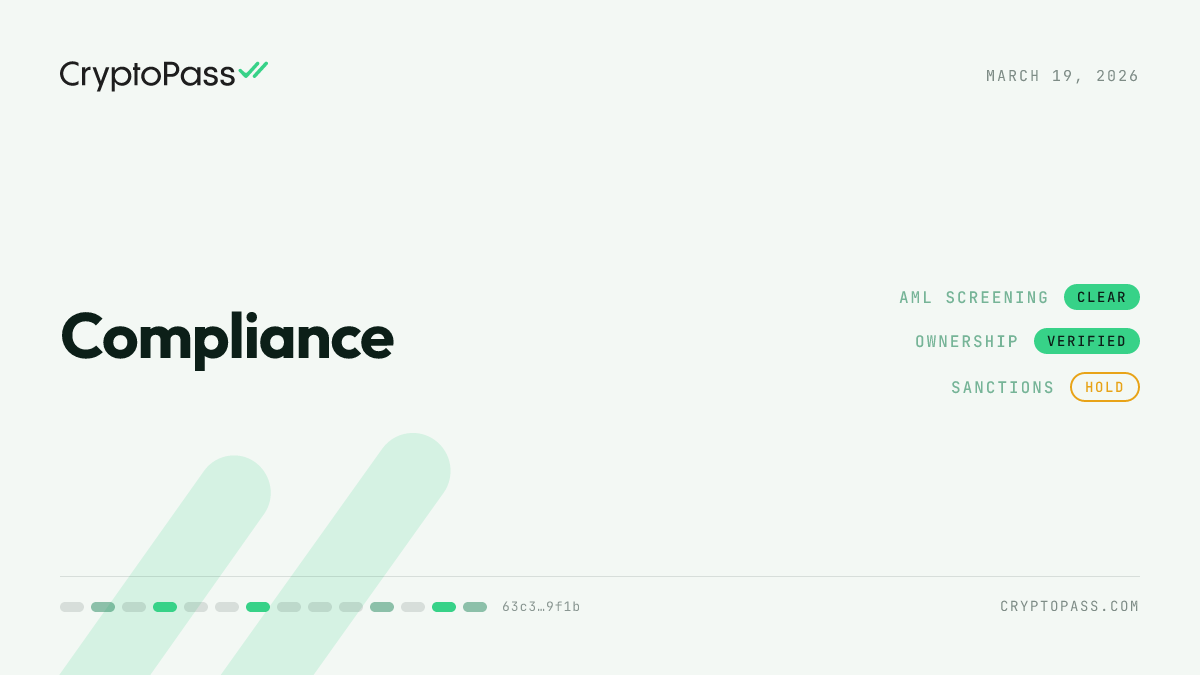
CryptoPass checks any non-custodial wallet for AML risk and verifies ownership on-chain, using either the Satoshi Test (a unique refundable micro-amount sent to a one-time address, confirmed in 1–3 blocks, on all supported chains) or WalletConnect (instant, no transaction, for Ethereum and compatible chains). The result is a KYW score from 0 to 100 — based on transaction history, counterparty risk, sanctions exposure, and ownership verification — packaged as a detailed PDF with a blockchain-verified hash, shareable by QR code or link. It supports BTC, ETH, SOL, TRX, GRAM, and USDT.
An independent legal opinion from July 2023 by Dr. Stephan Ochsner, former CEO of the Liechtenstein Financial Market Authority, found that the CryptoPass process aligns with state-of-the-art requirements for proving wallet ownership and supporting Source-of-Funds clarification under FATF, EU, and Liechtenstein standards.
To be clear about what it is: a KYW certificate is an informational compliance report, not a legal document, and no document guarantees a particular outcome — acceptance decisions always rest with the reviewing institution. What it does is answer, in independently verifiable form, the two questions a tax report leaves open.
When You Should Still Involve a Lawyer
Documentation solves the routine cases. Some situations need professional representation on top of it:
- Formal proceedings. If an account freeze has escalated into an AML investigation or a regulator is formally involved, get legal advice before submitting anything.
- Large inheritance or gift cases. Cross-border estates and substantial gifted assets raise tax and succession questions a screening report cannot address.
- Litigation and disputes. If funds are contested — a business breakup, a divorce, a creditor claim — the SoF question becomes an evidentiary one for lawyers.
A screening report documents facts. A lawyer argues your case. In serious matters you will likely need both, and clean documentation makes the lawyer’s job cheaper.
For everything short of that, preparation is self-service. The basic wallet check in the CryptoPass app is free, with no card and no KYC to start; a full KYW certificate costs from EUR 10 per wallet, with no subscription. See pricing or get the app.
FAQ
Is a source of funds certificate the same as a crypto tax report?
No. A tax report shows what you declared to the tax authority. A source of funds certificate documents where specific assets came from, what they touched on-chain, and that the wallet is under your control. They answer different questions and work best together in one package.
How do I prove a crypto wallet is actually mine?
Two standard methods exist: send a verified micro-transfer from the wallet to a one-time address (the Satoshi Test), confirmed on-chain within a few blocks, or verify instantly via WalletConnect on Ethereum-compatible chains, with no transaction needed. Screenshots of a balance are not proof — anyone can display any public address.
What is the difference between source of funds and source of wealth?
Source of funds is the direct origin of the assets in one specific transaction. Source of wealth is how you built your overall net worth over time. Reviewers ask about SoF routinely; SoW comes up for larger amounts, higher-risk cases, and politically exposed persons under FATF-aligned rules.
Will a KYW certificate be accepted by my bank or exchange?
No document can guarantee acceptance — that decision always rests with the institution. A KYW certificate provides what compliance teams typically request in one place: an AML screening result, cryptographic ownership proof, and a verifiable hash. It helps document the origin of your funds and supports your case; the outcome remains the reviewer’s.
This article is general information, not legal or tax advice.